Aluminum is the second most abundant metallic element in the Earth’s crust. Due to its recyclability, corrosion resistance, high specific strength, and especially its lightweight characteristics, aluminum alloys have become increasingly favored by the aerospace, automotive, and transportation industries over the past two decades.
These industries have shown a growing demand for thin-walled multi-cavity profiles, complex cross-sectional geometries, and lightweight products.
Hot extrusion is a key process for efficiently producing complex aluminum profiles, and the porthole die is one of the most commonly used die types in this process. However, die design directly affects product quality and production efficiency. Improper designs may lead to stress concentration, excessive die deformation, and even product rejection.
Researchers including Önder Ayer from Trakya University in Turkey and the aluminum extrusion die manufacturer “eksenAL” conducted a systematic finite element simulation study on the bridge design of porthole dies. The research results were published in Advances in Science and Technology Research Journal. This article presents the key findings of this study.
1. How Does a Porthole Die Work?
Before discussing optimization methods, it is important to understand the basic structure and working principle of a porthole die.
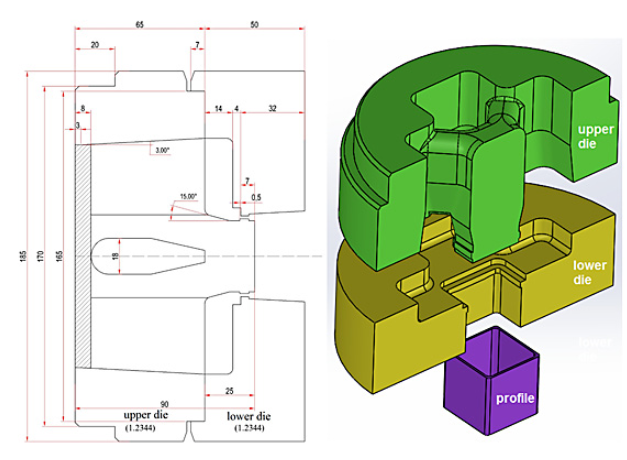
The figure above shows the overall structure of the porthole die. During extrusion, the AA6063 aluminum alloy billet is pushed into the die by the extrusion ram at high temperature. The material is forced to flow through four portholes, bypasses the bridge legs, enters the welding chamber, and finally passes through the bearing section to form the required profile shape.
The number and arrangement of portholes directly affect the uniformity of material flow, while the geometric design of the bridge is a key factor determining stress distribution and die deformation.
2. Four Bridge Designs: From Sharp Corners to Curved Structures
The core focus of this study was the geometry of the bridge structure. The research team designed four different bridge configurations, as shown in Figure 2.
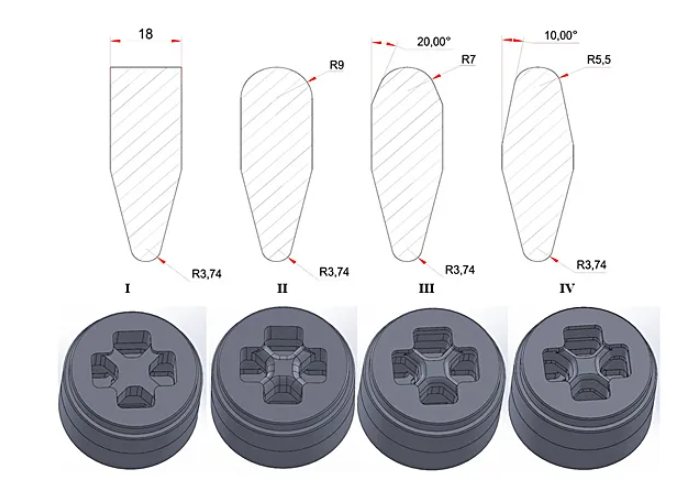
Die I (initial design): Sharp corner transition without fillet treatment.
Dies II, III, and IV: Gradually introduced larger fillets and curved transitions, with Die IV adopting the most pronounced curved bridge design.
All simulations were conducted under the same conditions:
Billet temperature: 450°C
Die and extrusion container temperature: 430°C
Extrusion ram speed: 5 mm/s
Material: AA6063 aluminum alloy
Die material: H13 hot-work tool steel
The simulations were performed using HyperXtrude Inspire Extrude Metal 2019, a finite element method-based simulation software.
3. Comparative Analysis of Key Indicators
3.1 Stress Distribution — A Key Factor Affecting Die Life
Stress distribution is a critical parameter for evaluating die service life. Lower and more uniform stress levels indicate longer service cycles and reduced maintenance costs.
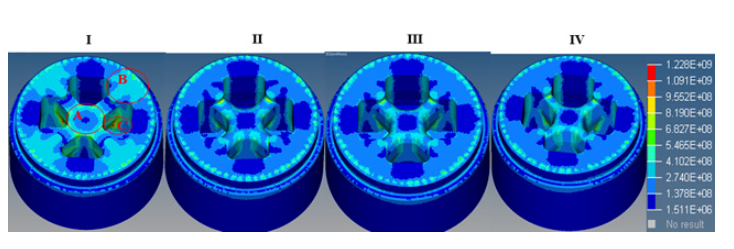
The results shown in Figure 3 indicate:
Die I showed a maximum stress value of 122.8 MPa, with obvious stress concentration appearing in regions A and C.
Die IV reduced the maximum stress to 85.2 MPa, representing a reduction of more than 30%.
The stress range in region B for Dies II, III, and IV was 41–68 MPa, significantly better than that of Die I.
The curved bridge design effectively reduced stress concentration and improved stress distribution uniformity.
3.2 Die Deformation — A Key Factor Affecting Product Accuracy
Die deformation directly affects the dimensional accuracy of extruded profiles. When deformation exceeds the allowable tolerance, the final product may deviate from the design requirements, resulting in product rejection.
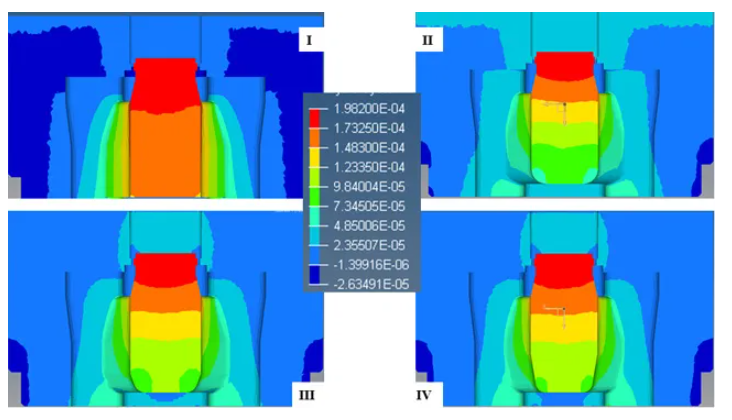
Figure 4 reveals several important trends:
Die I exhibited the largest deformation, particularly concentrated at the front end of the mandrel.
After introducing curved transitions and modified angles, Dies II, III, and IV showed significantly reduced deformation.
The deformation values ranged from 1.48–1.98 × 10⁻⁴ mm.
The curved bridge design changed the deformation distribution from concentrated deformation at the front end of the mandrel to a more uniform overall distribution.
This indicates that bridge design affects not only the magnitude of deformation but also the spatial distribution pattern of deformation.
3.3 Product Temperature — A Factor Affecting Mechanical Properties
The exit temperature of the profile is critical for dimensional accuracy and mechanical properties.
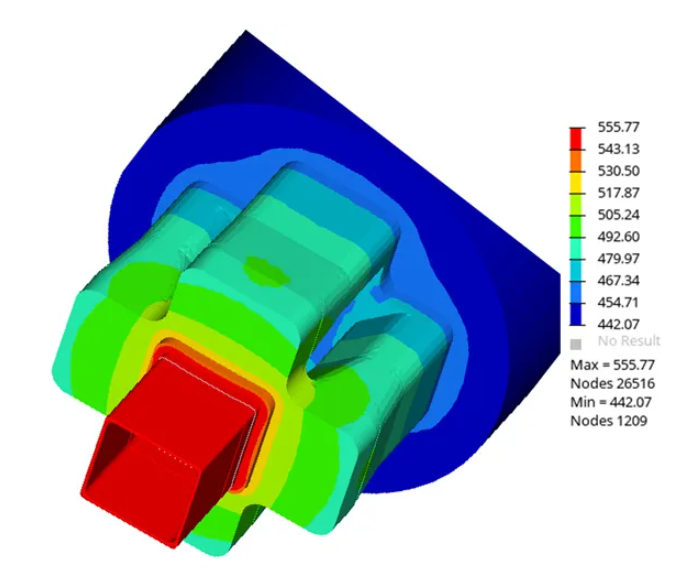
Under all four designs, the profile exit temperature remained approximately 555°C, with a uniform temperature distribution at different locations.
The billet temperature initially set at 450°C increased to 555°C during extrusion due to friction and stress conditions. The highest temperature appeared in the welding chamber area, which is beneficial for achieving good solid-state welding conditions.
The bridge design had no significant influence on product temperature.
3.4 Exit Velocity — A Factor Affecting Profile Straightness
The uniformity of material flow determines whether the extruded profile experiences bending or twisting.
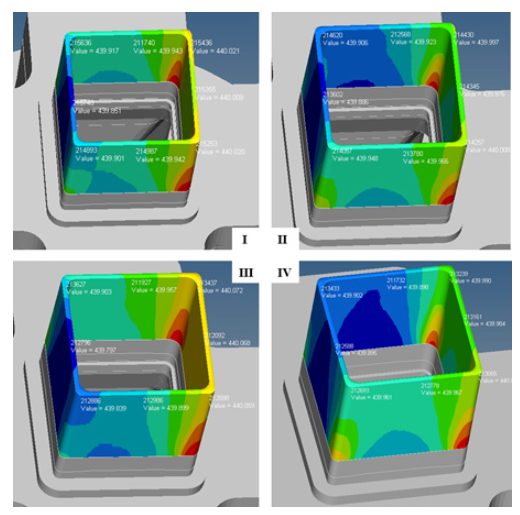
Under all four die designs, the profile exit velocity remained between 439–440 mm/s, with almost no noticeable difference.
The bridge design did not affect the exit velocity.
3.5 Die Temperature — An Indicator of Process Stability
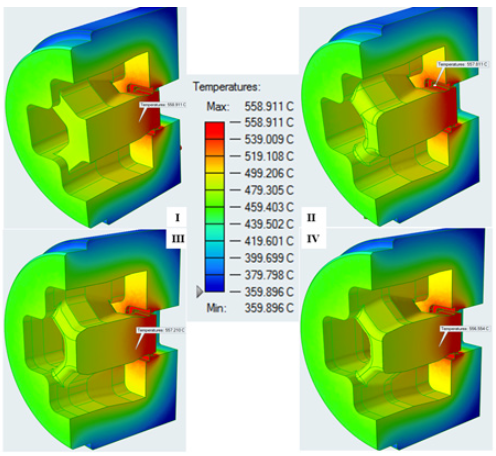
The maximum temperatures of the four dies were 558.91°C, 557.81°C, 557.20°C, and 556.55°C, respectively.
Although Die I showed a slightly higher temperature, the overall differences among the four designs were not significant. In all cases, the temperature concentration occurred near the die exit area.
The bridge design had a negligible effect on die temperature.
3.6 Forming Load — A Factor Affecting Extrusion Press Selection
Forming load is a decisive parameter for selecting extrusion press capacity and directly affects production costs and energy consumption.
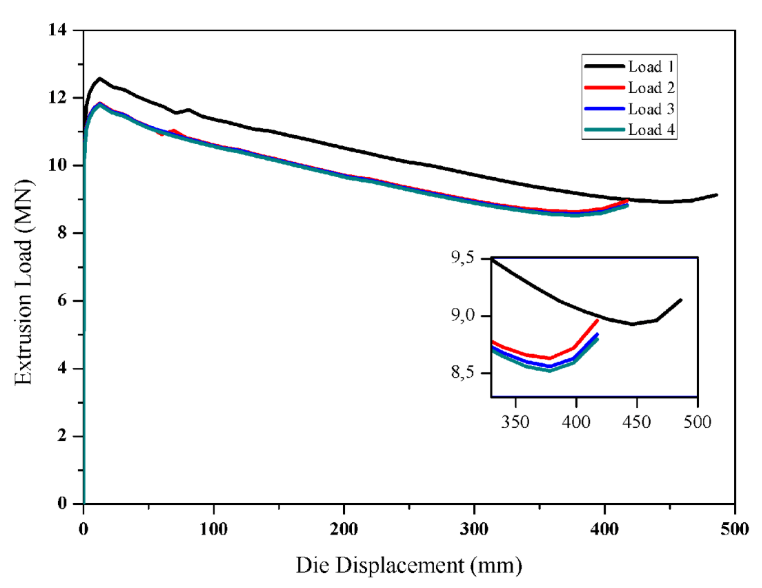
Figure 8 provides the clearest comparison of economic performance:
Die I required a significantly higher forming load than the other three designs.
Die IV showed the lowest forming load.
The curved bridge design effectively reduced resistance during material flow, thereby lowering the required forming load.
4. Conclusions and Engineering Implications
Through a systematic simulation comparison of the four bridge designs, the study reached the following key conclusions:
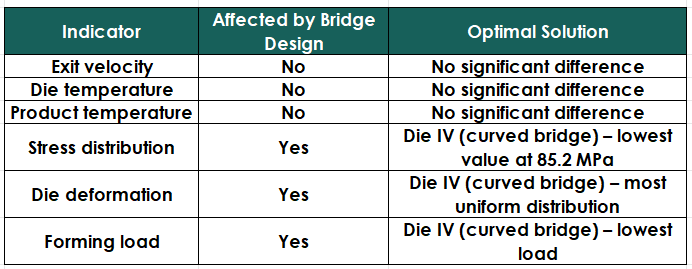
The curved bridge design is the optimal choice for porthole extrusion dies. By improving material flow, it reduces stress concentration and forming load, improves die deformation distribution, and therefore has the potential to extend die service life, reduce scrap rates, and lower extrusion energy consumption.
For aluminum extrusion die manufacturers and profile producers, introducing a curved bridge design during the die design stage may increase manufacturing complexity to some extent. However, the overall benefits—including longer die life, more stable product quality, and lower production energy consumption—fully justify this investment.

 Aluminum Extrusions
  Fabrication
 Surface Finishes
 Flat Rolled Aluminum