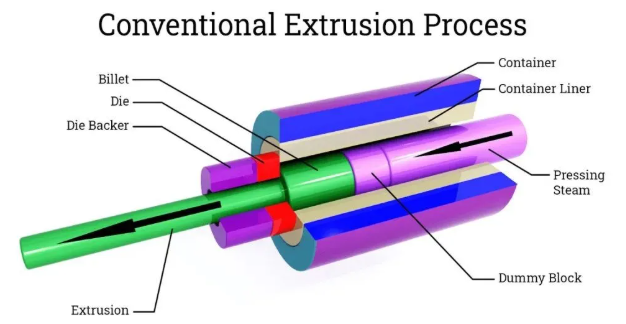
Compared with the more common 6xxx alloys, the fundamental differences in extruding higher-strength 2xxx and 7xxx alloys are as follows:
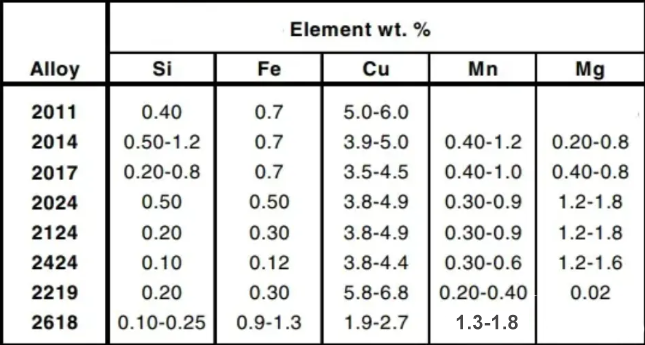
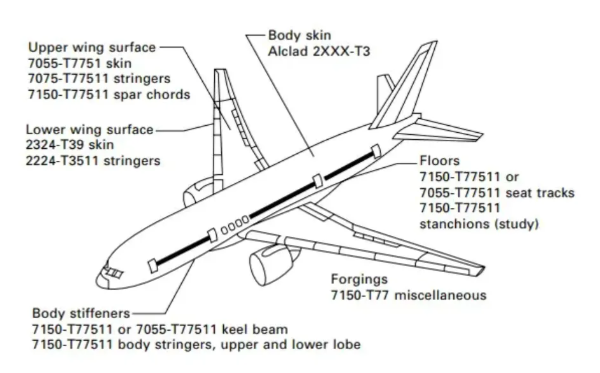
The main elements of typical 2xxx alloys are shown in Figure 1. The 2xxx series contains many groups. The Al-Cu group includes binary alloys such as 2219 (with 6% Cu). Al-Cu-Mg alloys (e.g., 2024 and 2014) are the most commonly used 2xxx series alloy extrusions in airframe structures. They evolved from the 2017 alloy discovered by Wilm in 1911. These alloys offer medium-to-high strength with good ductility and toughness. Alloys 2024 and 2014 are used primarily as structural members on the lower side of wings, where tensile, fatigue, and stress-corrosion conditions render many higher-strength 7xxx alloys unacceptable. Variants such as 2124 and 2224 have improved properties, especially fracture toughness, which is a combination of purity control, microstructure, and temper development.
The main elements of typical 7xxx alloys are shown in Figure 2. Alloys in the 7xxx series fall into two broad categories. The Al‑Zn‑Mg medium/high‑strength alloys have significantly better extrudability because they have lower flow stress, and most can be air‑quenched on the press. Al‑Zn‑Mg alloys such as 7003, 7004, 7005, and 7020 can be extruded using conventional hollow die techniques and are thus within the capability of most extrusion facilities. The high‑strength Al‑Zn‑Mg‑Cu alloys used in aerospace require separate solution heat treatment, need higher extrusion pressure, and cannot be extruded into hollow shapes without employing specialized seamless extrusion presses. The mainstay of the Al‑Zn‑Mg‑Cu alloys is 7075. Higher‑purity variants such as 7175, 7475, and 7150 offer improved fracture toughness, but with some loss in strength. This is addressed through the application of new overaging T7x tempers.
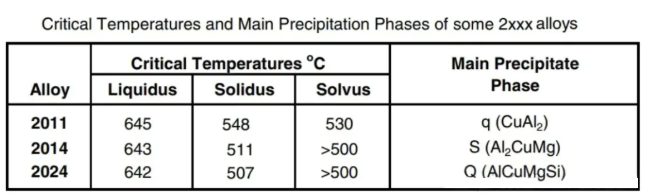
The critical temperatures and major precipitation phases of some 2xxx alloys are shown in Figure 4. Because many 2xxx alloys have a long solidification interval (the difference between liquidus and solidus temperatures), the solidification process is slow and dendrites form coarsely. Microsegregation tends to be significant, and dissolution during homogenization is slow, especially under commercial practices where the temperature must not approach the liquidus. The long solidification interval also affects the depth of inverse segregation on the billet surface, often requiring longer extrusion butt (up to 12%).
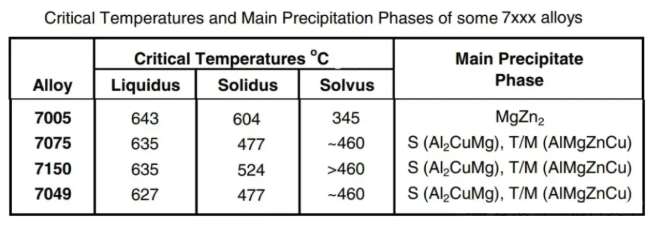
Common 7xxx alloys consist of two basic groups: the medium‑high strength Al‑Zn‑Mg alloys and the high‑strength Al‑Zn‑Mg‑Cu alloys. Critical temperatures and main precipitation stages are shown in Figure 5. The typically long solidification interval of Al‑Zn‑Mg‑Cu alloys produces microsegregation issues similar to those of the 2xxx series alloys.
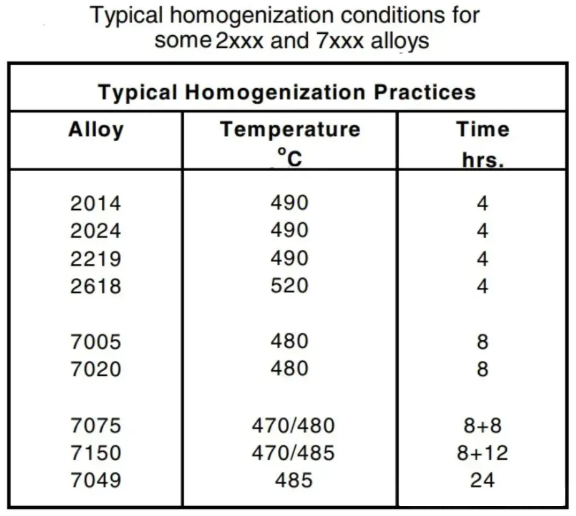
Typical billet homogenization practices for 2xxx and 7xxx alloy billets are shown in Figure 6.
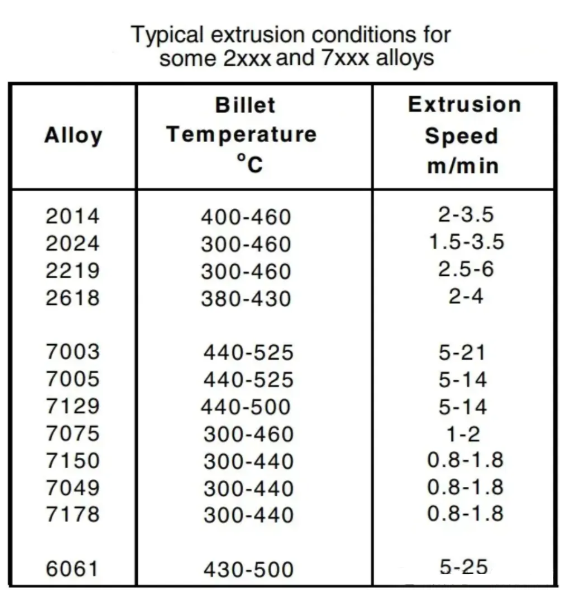
Typical extrusion conditions for some common 2000 and 7000 alloys are shown in Figure 7. 2000 and 7000 alloys are generally prone to recrystallization. Recrystallization is a complex interaction of billet composition, metallurgy, extrusion conditions, and critical temperatures (e.g., solvus, solidus, and recrystallization temperatures).
Al‑Zn‑Mg alloys such as 7005 can be air‑cooled on the press, enabling extrusion at die exit temperatures sufficiently above the solvus so that effective solution heat treatment occurs during passage through cooling fans. Moreover, the exit temperature is usually below the recrystallization temperature of these alloys, so recrystallization does not occur.
The higher‑strength Al‑Zn‑Mg‑Cu alloys are quite different. For each alloy, the solvus temperature is higher and closer to the solidus temperature. This eliminates the possibility of effective solution heat treatment via hot forming. Hence, separate furnace solution heat treatment is required.
For the 2xxx series alloys, the interval between solvus and solidus is very short, sometimes less than 10 ⁰C. Therefore, peripheral coarse grain recrystallization is more common and occurs to a greater extent in 2xxx series alloy extrusions.
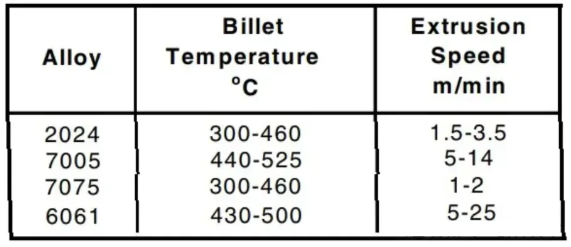
Figure 8 highlights how much slower the 2xxx and 7xxx series alloys extrude compared with the more common 6061 alloy. The lower solidus temperature and incomplete dissolution of low‑melting‑point phases during homogenization increase the risk of hot shortness, speed cracking, or tearing, thereby limiting higher extrusion speeds. In terms of extrusion pressure and speed, the Al‑Zn‑Mg group within the 7xxx series is easier to extrude than the higher‑strength Al‑Zn‑Mg‑Cu alloys. Typically, these alloys are extruded at exit temperatures not exceeding 530 ⁰C.
Extruders capable of extruding the higher‑strength 2xxx and 7xxx alloys can supply specialty markets such as aerospace, where prices are significantly higher than the typical prices for the more common 6xxx series alloys sold. However, the extruder must be familiar with the many issues associated with extruding and processing these high‑strength alloys.

 Aluminum Extrusions
  Fabrication
 Surface Finishes
 Flat Rolled Aluminum