The coarse grain ring is a ring-shaped or crescent-shaped zone of coarse recrystallized grains around the periphery of aluminum alloy extruded products. It is one of the most common and most difficult-to-eliminate microstructural defects in the production of 6xxx aluminum alloy rods and profiles. For 6082 (Al-Mg-Si) alloy, the coarse grain ring directly degrades rod strength, bend formability, and anodized surface quality.
This paper reviews the definition and adverse effects, formation mechanism, and main influencing factors of the coarse grain ring. It also summarizes control measures reported in patents and literature along the whole process chain of melting and casting, homogenization, extrusion, and heat treatment, for reference in process design.
The coarse grain ring results from the combined effect of severe shear deformation of the surface metal and abnormal growth of recrystallized grains. Its control logic can be developed along a process chain. Composition and dispersoids determine the resistance of the alloy to recrystallization. Extrusion parameters determine the degree of deformation inhomogeneity. Subsequent heat treatment determines whether the coarse grains become visible.
Coarse grain ring control should therefore weaken each link along this chain instead of relying on adjustment of a single process step.
The coarse grain ring refers to a ring-shaped or arc-shaped coarse-grained region distributed along the periphery of the cross-section of extruded products. Its grain size can reach 10 to 100 times that of the normal structure, approximately 800 to 1500 μm. Along the length of the product, the coarse grain ring generally deepens and becomes more severe from the front end toward the tail end. In severe cases it may extend across the entire cross-section.
According to the time of appearance, the coarse grain ring can be divided into two types. One type forms during extrusion and is mostly found in commercially pure aluminum and soft aluminum alloys. The other type becomes visible only after non-lubricated direct extrusion and subsequent quenching heating, and is mostly found in heat-treatable strengthened alloys such as forged aluminum and hard aluminum. 6082 is a typical example of the second type. The as-extruded surface layer may appear as fine grains or subgrains, and the coarse grain ring becomes evident only after high-temperature solution treatment.
The adverse effects of the coarse grain ring are mainly reflected in three aspects. First, the coarse-grained structure can reduce tensile strength by approximately 15% to 20%, and the microstructure and properties are unevenly distributed across the cross-section. Second, the coarse grain ring affects surface quality and subsequent processing quality. During stretch straightening, the surface becomes rough and orange peel appears. After anodizing, an obvious color-difference ring band appears. During bending, cracking readily occurs in the coarse-grained zone. This is particularly sensitive in applications requiring high surface and bending performance, such as automotive swing arms and architectural profiles. Third, coarse-grained zones have high grain-boundary energy, and corrosive media can readily penetrate along grain boundaries. This deteriorates welding performance, corrosion resistance, and fatigue performance. Because of its wide-ranging adverse effects, coarse grain ring depth is one of the core items in macrostructure inspection before delivery of rods and profiles. The microstructure inspection methods are given in the GB/T 3246 series.
The fundamental cause of the coarse grain ring is recrystallization, and its formation chain can be summarized in four steps.
First, during non-lubricated direct extrusion, strong friction exists between the billet surface and the inner wall of the extrusion container. The deformation degree of the outer metal is dozens of times higher than that of the central region, and the outer layer undergoes large shear deformation. The grains are severely fragmented, the dislocation density is high, the stored energy is large, and the recrystallization temperature is significantly reduced. The deformation degree of the product increases from the front end to the tail end, so the coarse grain ring also deepens from the front end to the tail end.
Second, the flow of the surface metal lags behind that of the center and is in an additional tensile stress state. This promotes the precipitation of elements such as Mn from solid solution. The precipitated dispersed second phase actually hinders grain agglomeration and growth in the as-extruded state. Therefore, the surface layer of the freshly extruded product often exhibits a fine-grained structure. This is also the reason why the second type of coarse grain ring is not visible during extrusion.
Third, the high quenching heating temperature causes the precipitated second-phase particles to redissolve, and the Zener pinning effect on grain-boundary migration is weakened or disappears. However, the residual distortion energy and recrystallization nuclei in the surface layer after primary recrystallization still remain, and the grain-boundary migration ability is strong.
Finally, a few recrystallized grains in favorable orientations rapidly grow by swallowing the surrounding fine grains. Abnormal grain growth or secondary recrystallization occurs, and the structure eventually consolidates into a macroscopically visible coarse grain ring.
The central region is less prone to coarse grains because its deformation is uniform and it is under compressive stress. In addition, Mn is not easily precipitated in the center, and the recrystallization temperature there is high.
In addition to the main path above, the critical deformation degree mechanism cannot be ignored. When the local deformation amount happens to fall within the critical deformation range, the recrystallization nucleation rate is extremely low while the driving force for growth is sufficient. This directly produces particularly coarse grains. Reverse extrusion studies on 6061-series alloys show that grain growth in the coarse-grained zone is mainly microstrain-induced recrystallization growth.
An excessively high exit temperature simultaneously aggravates both paths. High temperature makes the metal more likely to enter the critical deformation state. It also makes the already recrystallized fine grains more unstable and more intense in swallowing and growth.
The confirmed facts are as follows. The coarse grain ring is caused by recrystallization triggered by surface-layer shear deformation. Elements such as Mn and Cr increase the recrystallization temperature, and their compounds can hinder grain growth. The higher the homogenization temperature, extrusion temperature, and quenching heating temperature, the deeper the coarse grain ring.
Based on the evidence, it can be inferred that the coarse grain ring in 6082 mainly follows the path of becoming visible during solution heating. The as-extruded surface layer consists of fine grains or subgrains. After high-temperature solution treatment, the dispersoids redissolve, pinning fails, and grains abnormally grow into a ring.
However, under specific alloy composition ranges, die structures, and production rhythms, which link is the dominant factor still needs to be investigated one by one. This requires comparisons of macrostructure and high-magnification microstructure, actual exit temperature measurements, and other means. The dominant factor cannot be generalized.
Table 1. Main influencing factors of the coarse grain ring in 6082 extruded rods
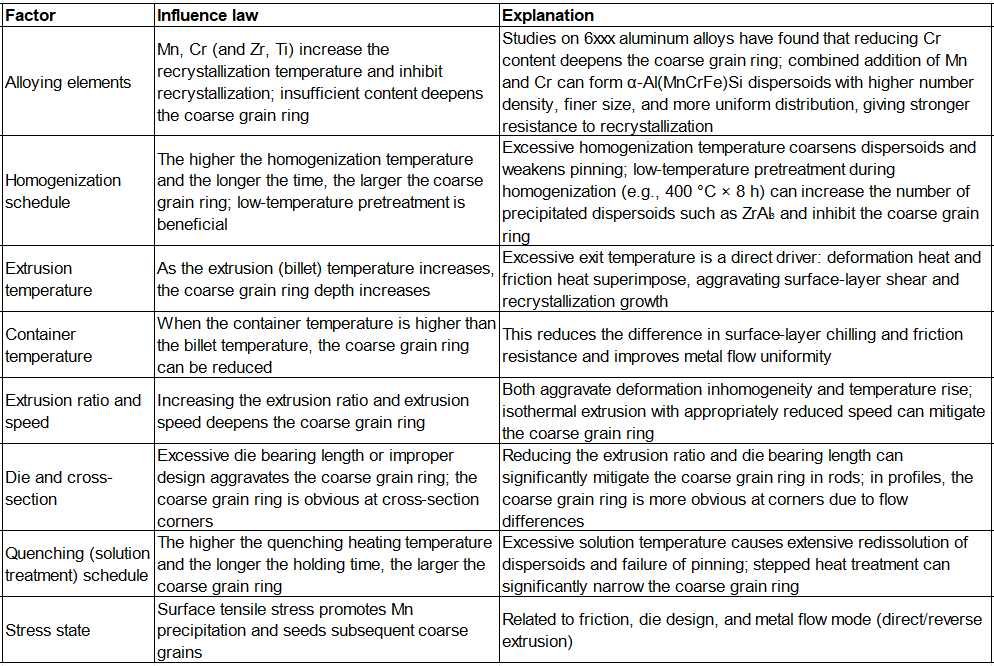
The most fundamental way to eliminate or mitigate the coarse grain ring is to reduce inhomogeneous deformation during extrusion and control the progress of recrystallization. For 6082 rod production, the measures can be summarized by process step as follows.
· Within the standard composition range of 6082, take Mn, Cr, and Ti toward the upper limits. Higher Mn, Cr, and Ti contents have a favorable effect on refining the grain structure of the product. They inhibit recrystallization by increasing the recrystallization temperature, thereby improving surface quality and bending performance.
· Use combined addition of Mn and Cr to form fine, dispersed α-Al(MnCrFe)Si phases. This balances recrystallization resistance and final performance.
· Control impurities such as Fe and maintain melt cleanliness to reduce coarse inclusions that can become recrystallization nucleation sites.
· Avoid single-stage high-temperature long-time homogenization.
· Adopt two-stage homogenization. First, use a low-temperature stage at approximately 310 to 330 °C for 10 to 15 h to fully pre-precipitate dispersoids. Then use a high-temperature stage in the range of 460 to 490 °C to complete microstructural homogenization. Patent practice shows that, combined with subsequent operations such as scalping or peeling, the coarse grain layer depth of the resulting 6082 profiles can be controlled within 3 mm while mechanical properties still meet standard requirements.
· Learn from the experience with Zr-containing alloys. Low-temperature pretreatment during homogenization can increase the number of precipitated ZrAl₃ dispersoids and significantly inhibit the coarse grain ring. Minor composition adjustments such as trace Zr addition to 6082 can be a research and development direction.
· Prefer isothermal extrusion. Through measures such as gradient heating of the billet and closed-loop speed control, minimize the temperature gradient across the product cross-section. Reverse extrusion tests on 6061 show that, with an appropriate speed and die preheating temperature, an exit temperature of approximately 453 °C can basically achieve isothermal extrusion and significantly mitigate the coarse grain ring.
· Appropriately reduce the extrusion speed to control the accumulation of deformation heat and friction heat and to avoid an excessively high exit temperature.
· Keep the container temperature slightly higher than the billet temperature to reduce the coarse grain ring.
· Under the premise of meeting production capacity, avoid blindly increasing the extrusion ratio. In rod production, reducing the extrusion ratio and die bearing length can significantly mitigate the coarse grain ring.
· Where conditions permit, use reverse extrusion or lubricated extrusion to fundamentally weaken the surface-layer shear caused by friction in the container. Multi-hole dies can also improve flow uniformity.
· Scalp or peel the billet before extrusion to remove surface segregation and structures prone to coarse grains.
· The higher the quenching or solution heating temperature, the larger the coarse grain ring. Therefore, under the premise of ensuring sufficient dissolution of Mg₂Si, use the lower limit of solution temperature and control the holding time.
· 6082 rods mostly adopt online quenching. Too low cooling intensity leads to insufficient quenching and insufficient performance, while too high cooling intensity leads to excessive distortion. In production, a graded cooling method of water mist first and then water immersion is often used to balance performance and dimensions.
· For high-end products sensitive to the coarse grain ring, consider stepped heat treatment. Before solution treatment, perform graded holding at 250 °C for 24 h, 300 °C for 24 h, 350 °C for 24 h, and 400 °C for 24 h. Use recovery in each temperature stage to eliminate deformation stored energy. In tests on ultra-high-strength Al-Zn-Mg-Cu alloy profiles, the average width of the coarse grain ring was reduced to one tenth to one seventh of that of the untreated material, and the uniformity of tensile properties in the thickness direction was significantly improved. This idea can be used as a reference for pre-recovery treatment of 6082, but process re-verification is required in combination with the overburning and aging behavior of 6082.
· Stretch-straighten extruded profiles after the temperature drops below approximately 50 °C to reduce the tendency for surface orange peel.
For 6082 rods, the three measures with the fastest on-site effects are usually as follows. First, apply low-temperature pretreatment or two-stage homogenization to the billet and combine it with scalping. Second, use isothermal extrusion or speed reduction with temperature control to keep the exit temperature under control. Third, strictly control the upper limits of solution temperature and holding time.
Composition optimization with Mn and Cr toward the upper limits and die design are medium- and long-term optimization directions. They should be advanced together with short-term process parameter adjustments.
At present, coarse grain ring control is still dominated by empirical parameters and trial-and-error verification. Several directions deserve further study.
First, numerical simulation and closed-loop temperature field control can be developed. Finite element tools such as DEFORM-type tools can be used together with measured exit temperatures to establish an isothermal extrusion parameter window and quantify the relationship between exit temperature and coarse grain ring depth.
Second, dispersoid engineering should be further explored. Through combined design of the Mn/Cr ratio and trace Zr, matched with the homogenization schedule, the pinning phase can retain a sufficient number density during high-temperature solution treatment. This is the main line of zero-coarse-grain-ring alloy design, and existing Al-Mg-Si-series zero-coarse-grain-ring patents provide examples of composition and process combinations.
Third, inspection standardization should be improved. For complex cross-sections, the measurement reference for coarse grain ring depth should be aligned with customers in advance during acceptance to avoid disputes. One example is using the shortest edge dimension as the depth reference for thin-walled tip regions.

 Aluminum Extrusions
 Fabrication
 Surface Finishes
 Flat Rolled Aluminum